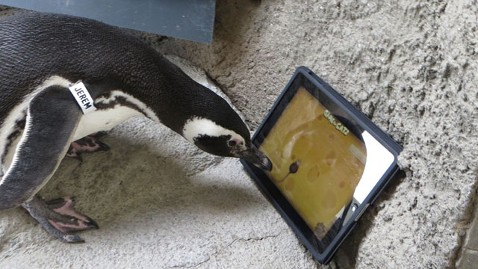
At the Aquarium of the Pacific in California, penguins showed sustained interest in games on a tablet. For the staff, this turned out to be not merely entertainment for the birds, but an additional way to hold their attention during routine monitoring procedures.
The situation illustrates well a broader trend in zoos and research centers, where digital devices are gradually becoming part of environmental enrichment. This is what they call a set of stimuli that reduce boredom and support animals’ natural exploratory behavior.
How a Cat Game Made Its Way to Birds
Sarah Mandel, a bird keeper at the Aquarium of the Pacific, initially bought a game from an app store for her cats. Then she became curious whether the same game mechanics would elicit responses to moving objects on the screen—and interest—in penguins, which rely on many visual cues in the wild.
According to Mandel, her supervisor’s initial reaction was skeptical, but it soon turned to surprise. She described it in a single string of phrases
“I asked for permission to show the game; he laughed at me. Then I showed it, and he was shocked that the penguins were actually interested in the tablet.”
The Tablet as Part of Care and Monitoring
The birds’ interest in the screen proved useful in practical terms. When the penguins are busy interacting with the tablet, the keeper gets a brief window for an inspection, which is usually harder to arrange without unnecessary stress and commotion around the enclosure.
In this logic, the device works as a gentle distracting stimulus rather than a replacement for interacting with the animal. Mandel lists the tasks that can be done while the penguins are focused on the game:
- a quick visual check of flippers and skin
- checking for injuries and signs of irritation
- unobtrusive weighing, when the scale is carefully slid under the bird, including a penguin named Lily
Mandel’s quote about the checkup and weighing
“While they’re just standing there spending time, I can look at their flippers. I can make sure everything is fine and they’re healthy, and I can even unobtrusively place the scale right under the spot where Lily is standing.”
This approach may seem routine, but there’s an important detail. For many species, monitoring body weight and limb condition is considered among the most sensitive indicators of health, while the procedure itself often requires precision and the animal to remain calm.
Not Just Penguins—and Not Just California
The Aquarium of the Pacific’s experience aligns with the practices of other American institutions, where tablets are used as a tool for training and cognitive enrichment. At Zoo Atlanta in the state of Georgia, different species worked with similar technology, and their responses differed in pace and persistence.
Among the animals that were offered interaction with the screen were:
- orangutans
- gorillas
- sun bears
It’s difficult to compare the effectiveness of such activities directly, because housing conditions, tasks, and motivation—for example, food reinforcement—usually do not match across different places.
Simple games are liked not only by animals. Many game developers today offer players simple, fast-paced entertainment because there is demand for it. This is especially relevant for arcade games, which are seeing another surge in popularity. And not only thanks to Nintendo’s popularity, but also due to the growth of the iGaming industry.
A vivid example is crash games, which are at the top of user rankings. As an example, we consider the Lucky Jet casino game, since it is a common and popular form of entertainment. The game features short rounds, and its rules can be understood in seconds. Simplicity and speed are the two main reasons for the popularity of this entertainment.
For modern people, such games provide a chance to relax, which is why they are so in demand. Who knows—maybe similar mechanisms are at work for us and for animals in that respect?
British Experiments with Touchscreens
In the United Kingdom, a group of researchers showed tablets to parrots and turtles. In scientific terms, these are touchscreens, where the animal touches the surface and the system records the choice and reaction time, which is convenient for standardized tests.
The goals of such activities differed. For parrots, the tablet served as a way to assess how the birds explore novelty and how they respond to changing stimuli, while for turtles the screen was used in tasks involving spatial orientation and movement, when the animal learns to find the correct courses of action.
Turtles, Neck Length, and a Marker of Calm
Anna Wilkinson, a researcher at the University of Lincoln, draws attention to a behavioral marker that is easy to notice without sophisticated sensors. According to her, the length of a turtle’s extended neck may indicate how comfortable the environment is, since a relaxed animal is more likely to keep its neck extended.
While working with the screen, Wilkinson described the turtle’s condition briefly and tellingly
“The neck was nice and long.” There’s a limitation in such observations, which the specialists themselves acknowledge, because posture also depends on temperature, arousal level, and individual differences, and not only on a sense of safety.
Why Screens Are Useful for Research and Care
Wilkinson emphasizes that touchscreens provide flexibility in selecting stimuli and help reduce human influence on the animal’s behavior. This argument is important for experiments where the researcher’s presence alone can affect the results, especially in wary or socially oriented species.
She also mentioned that she used electronic devices in training other animals, including dogs. Mandel, for her part, noted a more practical point. A computer, she said, can be more reliable than a person in routine scheduled tasks, for example when dispensing food, and it also distracts animals less because it doesn’t bring human gestures and inadvertent cues with it.
Attention Runs Out Quickly, Especially in Older Animals
Researchers working with tablets note a general limitation. Many animals have a short sustained attention span; they tire faster and lose interest, even if the task initially seems appealing and the stimuli on the screen change.
According to Mandel’s observations, this contrast is evident among the penguins as well. Younger birds are noticeably more willing to keep playing and follow the movement on the screen for longer, whereas older ones switch fairly quickly to other activities in the enclosure, which makes it harder to collect comparable observations.